Awenfold JournalStory ideas
From Female Draco to Original Fiction: How One Idea Becomes a Story
What the Malfoid and female Draco trend reveals about story ideas, character relationships, and turning one compelling thought into original fiction—with or without existing IP.
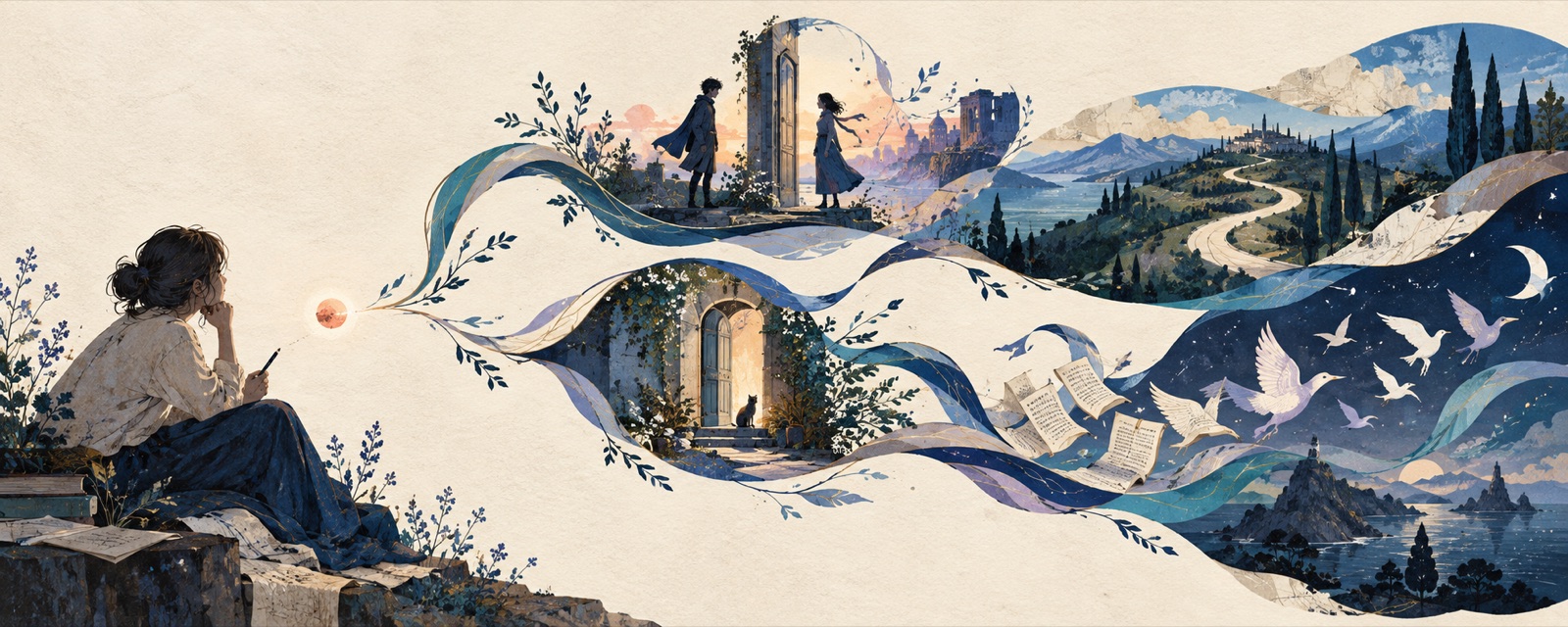
Sometimes a story does not begin with a world map, a character bible or a carefully planned ending.
Sometimes it begins with a thought that makes you pause for ten extra seconds.
The recent Malfoid trend on X—often described as “female Draco” or “Draco Malfoy as a woman”—is a useful example. The first image was striking, but an image alone does not explain why people kept returning to it, drawing it, animating it and writing entire scenes around it.
The real spark was a question:
If someone we already know stepped back into the same relationships with one important part of their identity changed, what would happen next?
That question can begin with existing IP. It can also begin with a character nobody has met before. The source matters less than the feeling it creates: I want to see the next scene.
This article is independent commentary about a fan-created internet trend. Awenfold is not affiliated with the Harry Potter franchise or the creators linked below. The original examples later in this article use no franchise characters, settings or visual assets.
Why one image became many stories#
The clearest starting point was REDTEN's September 22 post on X. When we checked it on October 18, the post showed 22.3 million views, 177,000 likes and 21,000 reposts. Those figures are a dated snapshot and will continue to change.
What happened afterward is more interesting than the size of the first number. A two-minute serial scene credited a separate story, comic and writing team. An AI-anime Yule Ball episode passed one million views. Another creator assembled a complete first story arc in reading and audio-ready formats, while the original artist announced plans to adapt parts of the story into comics.
New posts using Malfoid were still appearing minutes apart when we reviewed X on October 18. A shared label helped people find the art, animation, fiction and cosplay—but the label was not the story. Each new work was trying to answer an unfinished question in its own way.
This does not prove that every remix succeeds, that the attention will last, or that an original story will inherit the same audience. It does show how one memorable thought can keep producing scenes after the first image has done its job.
A good idea makes you want to see the next ten seconds#
The gender reversal is the visible change. The more interesting change happens in the space between characters.
Would an old rivalry begin to feel intimate? Would the same insult carry a different kind of tension? Would pride, fear or vulnerability become visible in scenes we thought we already understood?
Once an idea makes us imagine the next scene, it is no longer only a premise. It has narrative gravity.
That gravity does not require a vast world or a complete plot. It comes from pressure inside a relationship. Something has changed, the characters cannot behave exactly as they did before, and the audience wants to know which part of the old relationship will break first.
What existing IP lends: the known#
Familiar characters have one enormous advantage: the audience already knows who they are, what they want and what they owe one another.
A creator does not have to rebuild years of rivalry before starting a new interaction. Change one meaningful variable, and the audience automatically compares its memory of the old relationship with the possibilities of the new one. The friction between those versions creates energy almost instantly.
But the useful thing to borrow is the question—not the names, faces, costumes, spells or fictional world.
Copying the surface may capture attention for a moment. Finding the unresolved force inside the relationship can lead somewhere original. A disclaimer does not turn protected expression into a new commercial identity, and a look-alike image is not the same thing as a new story.
The creative move is to notice why the relationship started moving, then build different people who carry a conflict of their own.
Original stories can create the same pull#
Consider this idea:
A divorce lawyer who can hear every lie takes a murder case in which everyone is telling the truth.
We do not know this lawyer. We do not know the city, the victim or the rules behind the ability. Yet the sentence already opens a crack large enough for a story to enter. Why has the power failed? Is everyone innocent? What if the truth is more dangerous than a lie?
Or this:
A princess who wants to die hires an assassin who will do anything to stay alive as her bodyguard.
The characters are new. The world is new. But the relationship is in motion from the first second. Their desires oppose each other, and they still have to travel together. You can almost see the next scene before anyone writes it.
Neither idea needs borrowed lore to feel familiar. The first gives us a professional identity and breaks the one ability that made it safe. The second places two incompatible desires inside the same journey. In both cases, the story begins because the relationship cannot remain still.
A story idea is not a complete answer#
The best ideas rarely explain themselves all at once. They quietly contain three kinds of energy.
The known gives us somewhere to stand. It may be a recognizable relationship, profession, desire or fear.
The deviation makes us stop. Something in the familiar arrangement no longer behaves as expected.
The unfinished keeps us there. A choice has not been made, a cost has not been paid, or two people cannot continue together without changing each other.
That is why some premises can describe enormous worlds and still leave us with no desire to open the first page. Others are only one sentence long and stay in the mind all day. The first gives us information. The second gives us a relationship that cannot remain as it is.
An interesting idea also leaves room for the reader. It does not answer every question before the story begins. It creates space for someone to imagine a gesture, a line of dialogue or a consequence.
Online, that space can become collaborative. One person draws a possibility. Another writes the scene before it. Someone else imagines what happens afterward. The idea grows because it is specific enough to recognize and open enough to continue.
Follow the consequences, not a formula#
Perhaps the most exciting part of writing is not knowing the ending immediately. It is discovering that the idea can move one step farther.
A character makes a choice. The relationship changes. That change creates a new problem. Then the writer asks the simplest and most productive question in storytelling: what happens next?
Over time, a thought that once occupied only a few seconds begins to develop its own direction, rhythm and fate.
It may begin with a famous character viewed from a new angle. It may begin with a stranger glimpsed through a train window, a sentence misheard in a café, or a desire that seems impossible to admit. The source does not decide how far the story can travel.
What matters is whether the thought makes you want to see the next ten seconds.
If you have a line that keeps following you, Awenfold's free outline generator can help you see whether it wants to become a longer arc. If the idea feels more episodic, the short-drama story planner can explore how one consequence might lead to the next. Treat either result as a set of possibilities to judge and reshape—not as the answer hidden inside the machine.
Do not rush to explain the thought away. Follow it for a little while.
The story may already have begun.